

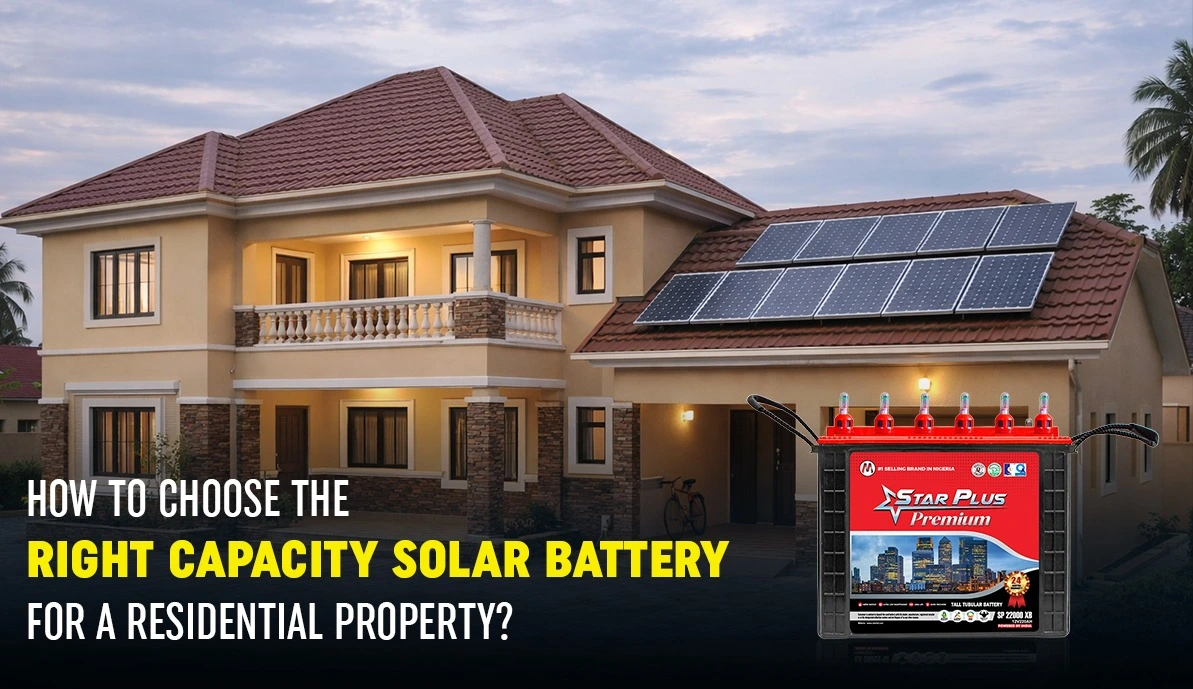
In a country like Nigeria, which suffers frequent power outages, determining the appropriate size for a solar battery system will be one of the biggest considerations for homeowners considering solar power. An appropriately sized solar battery will provide reliable backup power and increase the energy efficiency and longevity of your solar power system. Many homeowners will frequently ask, “What size solar battery do I need for my home?” and “What’s the 20% rule for solar?”
What is the 20% Rule for Solar?
At Star Plus Battery, following the 20% rule for solar helps your batteries maintain good health. The 20% rule for solar means that you should always keep at least 20% of your batteries’ total capacity available as a reserve. You should not deep-discharge your batteries, as doing so would damage them and shorten their service life.
You will improve the performance, service life, and reliability of your batteries by maintaining a 20% buffer. Most modern solar batteries have built-in systems that will automatically help to maintain the 20% rule. Manually enforcing the 20% reserve will help maximise your battery use.
Top Points to Consider When You Choose A Solar Battery Capacity
Some of the top points to consider when choosing a solar battery capacity are:
1. Daily Energy Consumptions
Evaluate how much electricity your household uses on a daily basis. It serves as the foundation for selecting the appropriate battery size.
2. Backup Duration
Just decide how long you want your battery to power your home, even during power outages.
3. Solar Panel Output
Your battery should match the energy generated by your solar panel to avoid underutilization and shortages.
4. Depth of Discharge (DoD)
Utilising the DoD in conjunction with the 20% rule of thumb for solar to avoid overusing batteries isn’t as simple as it seems. You’ll need to take into account how long you need the back-up power supply. A small size may be adequate if you only require back-up supply for a few hours. But if you require a larger back-up supply of power for overnight or extended outages, a larger-capacity battery will be necessary. Properly sizing your batteries helps prevent wasted electricity and saves you money by preventing you from ordering an insufficiently sized system.
5. Future Energy Needs
If you plan to expand your overall system and add appliances, choose a scalable battery solution.
The Types of Solar Batteries Used in Homes
When it comes to solar batteries, your options as a homeowner will be the following:
- Lithium-ion batteries are high-efficiency batteries that have long life spans and don’t require much maintenance.
- Tubular batteries are reasonably priced, will deliver power during outages, and can be used on a regular basis.
- Lead-acid batteries are inexpensive options that need regular servicing.
Each battery type serves unique purposes, so the best one for you will depend on your budget and how you plan to use it.
What are the common mistakes to avoid?
Always remain cautious and avoid these common mistakes when choosing a solar battery.
- Not at all, estimating your energy requirements accurately
- Not measuring the correct size solar battery for your household
- Not even following the 20% rule when installing a solar battery
- Buying a battery that cannot be used with your inverter system
- Using your battery too much may cause it to fail prematurely
If you avoid these mistakes, you will certainly experience better performance and longer battery life.
Choose The Right Size For Your Solar Battery
There are multiple benefits to picking an appropriate size for your solar battery:
- You can rely on backup power when the electricity goes out
- Efficient energy storage means lower energy bills
- The duration of battery life can be improved by using the battery properly
- The performance of your solar system overall will be improved
By being the right size, your solar battery will help you maximise the value of your solar investment.
Want to Buy Tubular Inverter Battery for Your Home and Office?
How Big of a Solar Battery Do I Need for My House?
The answer to how big a solar battery I need for my house fully depends on your daily energy consumption and backup requirements.
- Simply start by calculating your electricity usage in Kilowatt-hours (kWh).
- In small homes, you need 2 to 5 kWh to run the lights, fans, and basic appliances.
- When it comes to a home of medium size, you at least require 5 to 10 kWh of power to run Televisions, refrigerators, and washing machines.
For large homes, you definitely require 10 kWh+ of air conditioning and heavy appliances.
Conclusion
Choosing the appropriate solar battery capacity for your home is critical for achieving energy independence and long-term savings. As a result, by understanding how big a solar battery you require for your house and applying the 20% rule for solar, you can make a smart and informed decision.
As solar adoption continues to grow, investing in the right battery capacity ensures an uninterrupted power supply, improved efficiency, and a sustainable future for your household.
0 Comments