

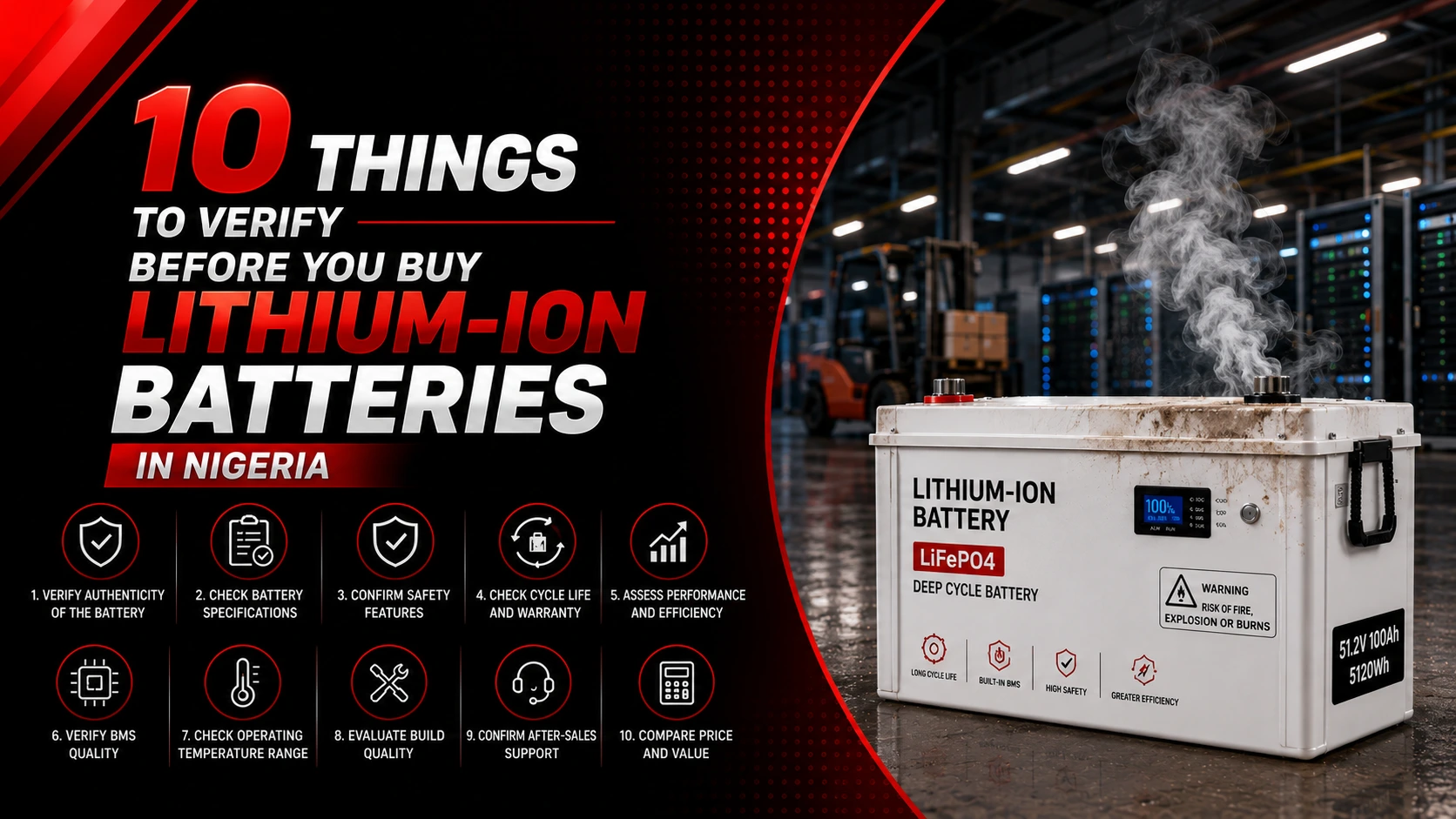
Lithium sounds smarter, but is it? While the technology can be advanced, the manufacturing techniques and quality maintenance remain highly questionable.
In February 2026, Kano Singer Market, a renowned business center in Nigeria, experienced a catastrophic fire caused by poorly installed lithium-ion solar batteries. With unreliable technology and low-quality lithium batteries in circulation across Nigeria, users and businesses are at significant risk.
So, what to do? Here’s what you need to verify before you buy lithium-ion batteries in Nigeria, and what can be a safer alternative.
1.Is my inverter fully compatible?
Most lithium battery users face a common problem of incompatibility with inverter systems. Many unethical lithium battery sellers offer a compatibility trap with inverters. If your inverter is not compatible with your lithium battery, there can be a high risk of short circuits when connected.
Lithium often pushes the customer into a specific inverter, protocol, app, technician, and service chain. This can increase total purchase costs, replacement costs, and make inverter-based power backup costlier.
2.Does it support CAN/RS485 communication?
Many lithium systems need proper CAN/RS485 communication. Without correct communication from the lithium battery, the inverter may not correctly read the state of charge, temperature, charging limits, or protection signals.
3.Is the BMS proven and certified?
Lithium Batteries depend on the Battery Management System. If the BMS is weak, poorly configured, or incompatible, the entire lithium battery becomes questionable.
Lithium systems operate within defined voltage windows. Poor matching and improper BMS communication can cause sudden cut-offs, undercharging, over-discharge protection, or performance complaints.
4.Who will repair it if it fails?
The machine is bound to cause a fault at some point in its lifecycle. If you want to purchase a lithium battery, ask who may repair it if it fails.
Most lithium batteries are sealed and not practically repairable in local markets except for limited BMS-related intervention. When the lithium battery fails, the ordinary customer cannot open it, test it, refill it, repair it, or even understand what’s wrong.
5.Is the capacity claim verifiable?
Unethical lithium battery sellers often market their products by focusing on kWh, cycles, and depth of discharge. Even if big claims like 10-year life, zero maintenance, and deep discharge capacity, the fire risks associated with lithium batteries from thermal runaway are not conveyed to users, nor are the consequences attached.
6.What happens if the seller disappears?
Many lithium battery users face the problem of the seller disappearing after an unauthorized battery sale. Low-quality lithium battery circulation has become widespread in Nigeria, leading to operational unreliability.
Moreover, lithium punishes poor installation, weak wiring, incorrect settings, poor ventilation, and careless commissioning.
7.Is the warranty replacement simple or full of conditions?
Lithium is often sold as a shortcut to premium profit, and not always as a properly engineered system. A long warranty is only valuable if the seller remains available, diagnosis is transparent, and replacement conditions are practical for the customer.
8.Why is the price dropping so fast?
If your lithium battery dealer says the product is getting cheaper every few months, as a customer, you must ask what is being reduced: cell quality, BMS quality, warranty, capacity honesty, or after-sales responsibility.
9.Is it a genuine engineered system or just a sealed box with big promises?
What you must always ask is whether the lithium battery is a genuine engineered system or just a sealed box with big promises. Even if both the inverter and battery are branded, communication may fail if firmware or protocol settings do not match.
10. Am I buying technology or am I buying confusion?
As a consumer, you have the right to ask: Are you buying technology, or are you buying confusion? Sudden fires and battery explosions are common with lithium batteries worldwide, and Nigerian users are no exception.
A tubular battery warns you before failure; lithium can cut off abruptly when protection systems or communication fail. It is not that lithium is bad. But for ordinary Nigerian mass market and local weather conditions, lithium batteries are unsuitable, unless every condition is perfect.
What’s a Safer Alternative to Lithium-Ion Batteries?
So, what can be a safer alternative to lithium-ion batteries? Most consumers choose Tubular Inverter Batteries for their safety.
When consumers choose tubular batteries, they should be properly informed about battery technology, protection designs, and minor home repairs that can prevent additional costs.
A consumer is easily guided on how the battery works, the maintenance procedures, the service route, the technician, and the economics.
Here’s how tubular inverter batteries work as a safer alternative to lithium batteries:
- Tubular is the natural mass-market choice because it fits Nigerian affordability, weather conditions, and power requirements.
- Tubular does not force the customer into a complex inverter-BMS ecosystem. It is generally compatible with solar, hybrid, and conventional inverter systems.
- Tubular has a visible maintenance and degradation pattern; lithium hides the problem inside electronics.
- Tubular gives the customer more control by enabling checking of electrolyte levels, monitoring performance, verifying charging compatibility, and detecting any signs of malfunction at an early stage.
- Tubular supports local technician livelihoods; lithium centralizes control with fewer specialized technicians.
- Tubular is better for customers who want dependable backup without technical drama.
Final Thoughts
Are you looking for a compatible tubular battery for your homes, offices, and industrial centres? We can help. At Star Plus Battery, we provide high-capacity tubular batteries, designed specifically for Nigerian power needs.
Connect with us today for any battery purchase, bulk orders, repairs, replacements, and installations.
0 Comments