

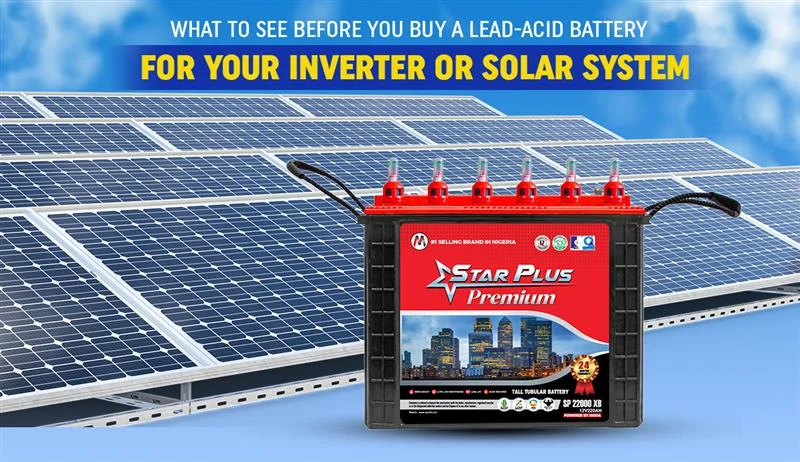
As we all know, power outages are common in residential and commercial setups in Nigeria due to unreliable electricity grids. That’s a reason behind the power disruptions one faces at home or the office. In this situation, what saves you is an inverter or a solar system to provide uninterrupted power and run operations without delay. For years, Star Plus’ lead-acid inverter battery has been a top choice among users across the country for seamless power during extended blackouts. Battery lifespan and affordability are the major factors that determine your decision to choose the right lead-acid battery. But there is more to it.
You must consider other important factors before buying an inverter or a solar system battery for a seamless power supply. Let’s have a read through the blog to know more about how to choose a lead-acid battery for your solar or inverter system.
System’s Power Demands
Your power requirements are the total amount of power you need to operate all the appliances with your inverter. Before you decide on your purchase of a lead-acid inverter or solar battery, check the power demands of your solar or inverter battery. See how much load the lead-acid battery can handle, check the wattage of each device on its label or manual, sum the total wattage of all devices, and make sure the battery can power all devices at the same time, etc. For instance, if you want to run a laptop, a fan, a TV, and three bulbs on your inverter, the load requirement would be –
- Laptop – 60W
- TV – 150W
- Standing Fan – 50W
- 3 Bulbs – 9 × 3 W = 27W
Total load requirement would be = 60 + 150 + 50 + 27 = 287W
Always choose an inverter that is at least double the power of your electricity loads. The high capacity provides more space for power and reduces the risk of power overload. In case you have a load requirement of 287W, the inverter should be 500W or above. And you must opt for a lead-acid battery with a preferred capacity to fulfil the power needs.
Measuring the Battery Capacity
Battery capacity (Ah – ampere-hours) is one of the most important factors to consider. The number reflects how much electricity your battery holds. You can determine the ideal capacity of your battery based on your energy consumption. A 12V 220Ah battery is the right choice when you have lights, fans, fridges, and other electronic gadgets to run at your home.
Lead-acid batteries are the traditional choice, widely available and requiring minimal maintenance. Over the years, battery capacity decreases due to sulfation. Battery capacity degradation depends on factors such as charging and discharging regimes, the battery’s DoD, prolonged exposure to low discharge rates, and the battery’s average temperature.
DoD (Depth of Discharge)
Depth of Discharge (DoD) shows how much battery capacity you can use without causing any damage to it. When you plan to buy the best tubular battery for solar inverter, you must check the battery’s depth of discharge. It means the amount of electricity a battery can store when fully discharged. It’s a key indicator of how much of the stored electricity you actually use. DoD assesses the amount of the battery’s storage capacity that has been consumed.
Lead-acid batteries are the oldest form of rechargeable battery technology and have an average DoD of 50%.
Here is how we calculate DoD in amps –
Discharge current (in amps) × length of the time of battery discharge / 60 minutes/ nominal battery capacity (in amp hours) = depth of discharge
For example –
A battery has a nominal capacity of 400 amp-hours.
If the battery discharges a load of 200 amps in 10 minutes, the calculation is –
200 amps × 10 minutes = 2000
2000/60 minutes = 33.33 (the state of discharge)
33.33/400 amp-hours = 0.08325
The battery gives you an 08.325 DoD (Depth of Discharge)
Battery Lifespan
Star Plus, one of the top-rated lead-acid battery suppliers in Nigeria, manufactures lead-acid batteries that not only feature a long lifespan but also support powerful operations. The battery’s warranty period is 24 months. However, tall tubular lead-acid batteries can last up upto 4 to 5 years depending on the usage and maintenance.
Cost Effectiveness
The fast, low-cost manufacturing process makes lead-acid batteries an affordable choice for buyers. Moreover, the battery needs the least maintenance. The batteries only need to be topped up with distilled water at a regular interval. Durability, low maintenance, and sustainable backups make Star Plus lead-acid batteries a cost-effective choice.
Want to Buy Tubular Inverter Battery for Your Home and Office?
What maintenance services are offered by tubular battery companies?
The tubular battery companies in Nigeria offer maintenance services, including water-level checks, topping inverter batteries with distilled water, cleaning terminals, cell or connection repairs, and post-installation support. Star Plus offers buyers common maintenance and repair tips to reduce the risk of additional maintenance and repairs.
Lead-Acid Battery for Your Inverter FAQs
- Install the batteries in a well-ventilated place to avoid extreme heat.
- Keep the battery away from direct sunlight.
- Place the battery on a stable surface to prevent leaks and damage.
- Check the electrolyte level and top up with distilled water on time.
- Clean the battery terminals at certain intervals.
- Inspect the battery regularly.
0 Comments