

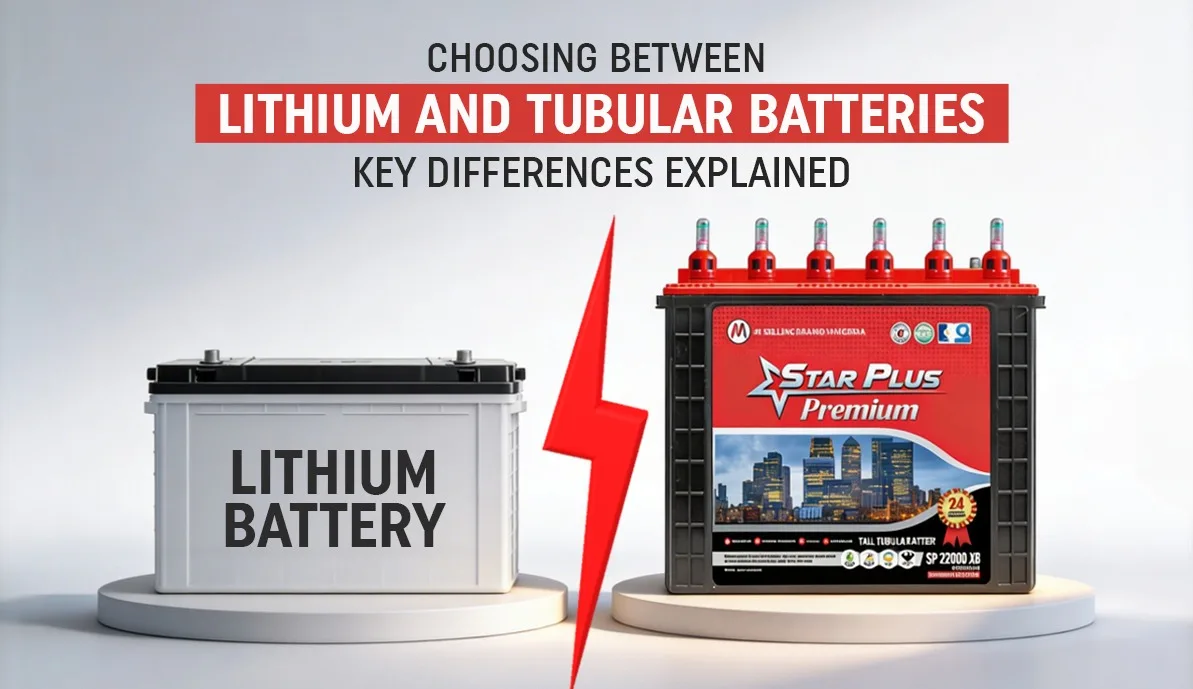
Selecting the right battery for your home or business can be a tricky choice. With options flooding the market, Lithium and Tubular Batteries often top the list. While both battery types have advantages, they also have distinct benefits and limitations.
In this blog, we have discussed the key differences between a lithium-ion battery and a tubular battery that may influence a customer’s decision. If you are planning a 4–5 year investment in a power backup solution, this guide can serve as a helpful reference.
Upfront Purchase Price Comparison
The first factor most buyers consider is the initial investment. Lithium batteries often come with a higher upfront cost, while tubular batteries include moderate rates.
| Battery Type | Upfront Cost | Key Considerations |
| Lithium Batteries | Higher | Advanced technology, compact design |
| Tubular Batteries | Moderate | Proven reliability and accessible pricing |
For households seeking long-term power backup solutions, balancing initial cost with expected performance is an important consideration.
Installation Cost and Compatibility
The second factor will be to consider installation cost and compatibility. Lithium batteries may require specific compatible systems, depending on the setup. Tubular batteries, however, are widely compatible with any inverter systems, making the installation easier.
| Battery Type | Installation Complexity | Cost Implication |
| Lithium Batteries | Moderate | May require compatible systems and dedicated setups |
| Tubular Batteries | Simple | Works with most standard inverter systems |
The compatibility of tubular batteries with an inverter makes them easier to integrate into existing setups without significant modifications.
Usage and Maintenance
Maintenance requirements also heavily influence how convenient a battery is for everyday use. While lithium batteries are often valued for their maintenance-free design, tubular batteries are designed to perform consistently over time:
Lithium Batteries
- Typically maintenance-free
- Compact and sealed systems
- Require compatible charging systems
Tubular Batteries
- Require periodic water top-ups (usually every 5–6 months)
- Maintenance is simple and predictable
- Known for stable performance with regular upkeep
Long-Term Cost Per Hour (4 – 5 Year Perspective)
Looking beyond the purchase price is necessary. That’s when evaluating the long-term cost per house for an inverter battery is required.
| Battery Type | Typical Lifespan | Approximate Backup Hours | Cost Efficiency Over Time |
| Lithium Batteries | 5-6 years or more | 1500–2000 hours | Higher initial investment |
| Tubular Batteries | 4–5 years or more | 1800–2200 hours | Balanced long-term value |
Over a period of 4-5 years, tubular batteries provide a consistent backup while maintaining a balanced cost structure. Lithium batteries might be efficient, but when measured in terms of backup house relative to investment, tubular batteries provide a long-term value.
Residual or Resale Value
Another factor that often goes unnoticed is the value a battery retains after its lifecycle. A modest residual value can contribute to the overall cost equation.
- Lithium Batteries: Disposal and resale options may be limited depending on the system and usage conditions.
- Tubular Batteries: Often retain a residual or scrap value, which can slightly offset replacement costs.
Major Limitation of Lithium-Ion Batteries
Power backup systems are often used in conditions where consistent performance is essential, such as frequent power cuts and usage. However, lithium-ion batteries pose a major safety risk to the system.
Thermal Runaway
Thermal runaway is a condition in lithium-ion batteries in which an increase in temperature triggers a self-sustaining reaction that rapidly heats the battery. Thermal runaway can be triggered by factors such as overcharging, internal short circuits, physical damage, manufacturing defects, or exposure to very high temperatures.
Once the process begins, the heat can accelerate further chemical reactions inside the battery, potentially leading to gas venting, fire, or, in rare cases, an explosion. Lithium-ion batteries are highly effective, but the constant risk of sparking may remain.
Practical Considerations for Home Backup
When evaluating batteries for home power backup, a few practical aspects often influence the final decision:
- Compatibility with inverters
- Ease of installation
- Long-term operating cost
- Performance during frequent power outages
Tubular batteries have been a trusted option in many homes because they meet these practical requirements. Their design and compatibility with existing inverter systems make them particularly suitable for long-term household backup needs.
Making the Right Choice
Both lithium and tubular batteries have their strengths, and the best choice often depends on the user’s specific requirements.
Lithium batteries are compact, technologically advanced, and require minimal maintenance. A tubular battery, meanwhile, is known for its robust construction, consistent performance, and balanced long-term value.
For users planning a 4–5 year investment in a reliable power backup system, comparing factors such as upfront cost, maintenance, installation, and lifecycle value can help determine the most suitable option.
Want to Buy Tubular Inverter Battery for Your Home and Office?
Conclusion
In 2026, power backup systems have become an essential part of every Nigerian household. At Star Plus Battery, we offer the best tubular batteries for 24*7 power solutions. With both Star Plus Lite and Star Plus Premium, you can power up your home, office, and even business.
For any battery purchase, installation, bulk order, repair, or replacement, connect with us today.
0 Comments